
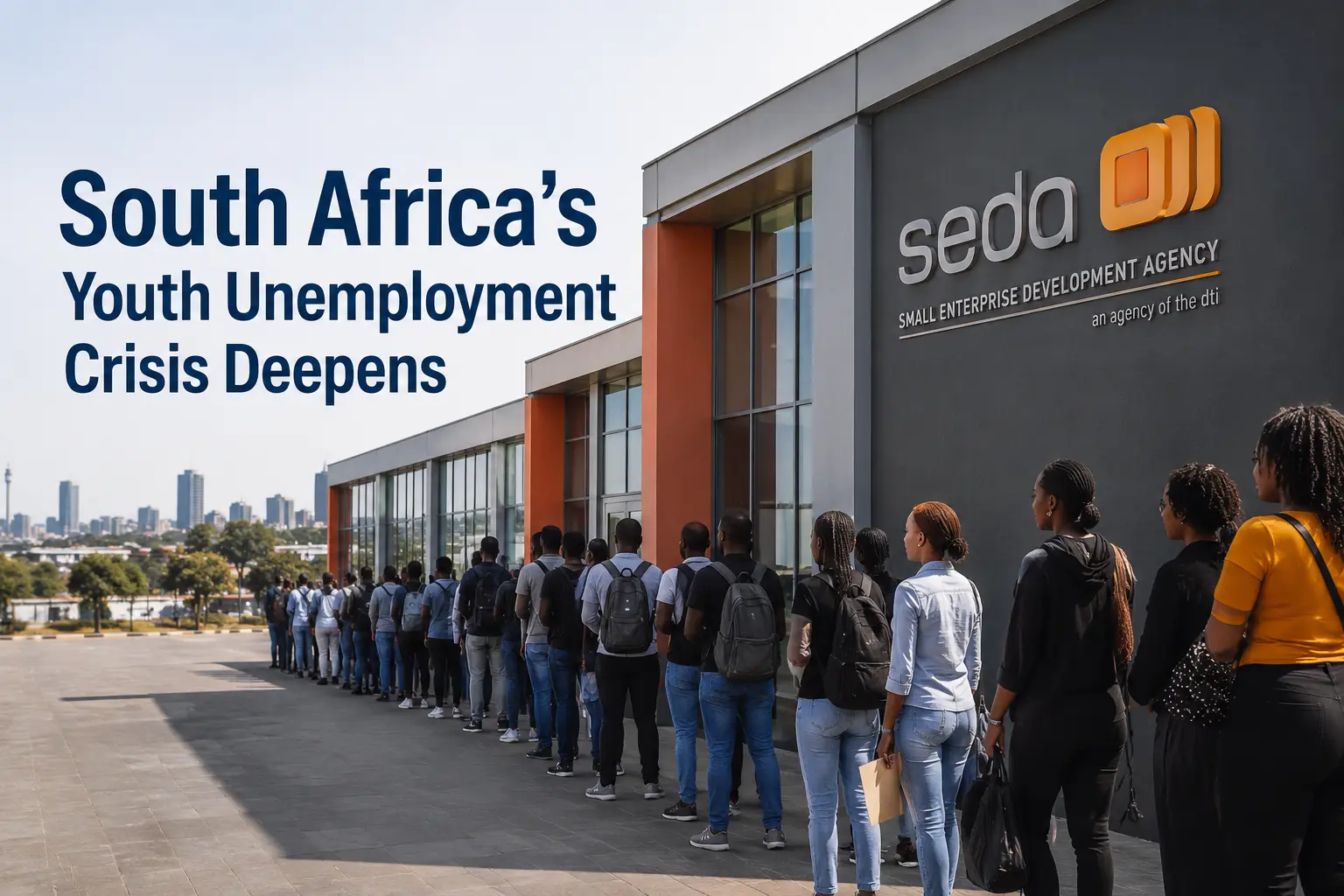
South Africa’s Youth Month 2026 coincides with the 50th anniversary of the 1976 Soweto Uprising – and the country’s youth unemployment challenge is far from resolution, despite policymakers focusing heavily on skills-development reforms.
Statistics South Africa’s (Stats SA) labour-market figures for the first quarter of 2026 reveal why skills are so integral to South Africa’s economic and social future.
While Stats SA’s quarterly survey shows that millions of 15- to 34-year-olds are unemployed, the youngest job-seekers are far more likely to be unemployed than older workers.
At the same time, government is in the process of reviewing the post-school education system, seeking to place greater emphasis on occupational qualifications and work-place training than in the past.
This confluence of factors makes for a complex set of challenges that define Youth Month 2026 – namely, how can South Africa transition its youth from education and unemployment into economic productivity?
South Africa’s Youth Unemployment Rate Far Exceeds the National Rate
Stats SA recorded an overall national unemployment rate of 32.7% in the first quarter of 2026.
But youth unemployment – which encompasses people aged 15 to 24 – far exceeds the national rate, hitting 60.9%.
Unemployment among 25- to 34-year-olds also greatly exceeded the national rate, clocking in at 40.6%.
You can also visit our Whatsapp Channel For More Opportunities Update
Stats SA cross-tabulated these figures for the 15-to-34 demographic, yielding the following:
Working-age youth of 15+ 21.0 m 5.6 m 4.7 m 10.6 m
These figures provide context for youth unemployment in South Africa. Youth comprise nearly half of South Africa’s working-age population, but their numbers in employment are far lower than those of older workers.
Millions of Young South Africans Are Not in Employment, Education or Training
Another telling indicator is the percentage of young people who are NEET (not in employment, education or training).
In the first quarter of 2026, 3.9 m (or 37.6%) 15- to 24-year-olds were NEET.
This constitutes a large body of young people with no direct access to economic participation or qualifications.
For the 15- to 34-year-old cohort, NEET figures climbed to 45.6%.
Stats SA also noted a stark gender divide for NEET figures, among 15- to 24-year-olds.
Young women are statistically more likely to be NEET than their male counterparts: 39.2% versus 36%.
The implications of these gender differences have serious consequences for South Africa’s growth prospects.
The First Job Is Often a Major Barrier to Employment
For young people, the problem is not just vacancies.
First-time job-seekers often need the experience and networks that come with a first job.
Harambee Youth Employment Accelerator’s research underlines the importance of first jobs, given the huge challenge that first-time job-seekers face.
Harambee’s May 2026 Breaking Barriers report notes an expanded youth unemployment rate of 54.65% for 18- to 35-year-olds in the first quarter of 2026.
According to Breaking Barriers, 255,000 fewer young people were in employment in the first quarter of 2026 than in the previous year, with numbers down across genders.
Within sectors, retail, construction and community and social services reported the largest drops in youth employment.
Harambee’s figures differ from Stats SA’s in that Harambee focuses on 18- to 35-year-olds and not 15-year-olds.
While the difference may seem technical, it is important not to conflate the two sets of figures.
Why Getting a First Job Matters
The main point made by Harambee’s research is that obtaining a first job – and thus, first-hand experience of the workplace – presents significant barriers to young people.
Harambee’s report suggests that programmes aimed at getting young people into the workplace are critical to overcoming this hurdle.
Such programmes include:
Learnerships Internships Apprenticeships Graduate programmes Other workplace-based learning initiatives
The value of such programmes lies not in guaranteeing jobs to programme-completion, but in providing the workplace experience that many first-time job-seekers lack.
For first-time job-seekers, the ability to navigate a professional environment can open doors just as much as a qualification.
Government Prioritises Occupational Qualifications in Post-School Sector
South Africa’s youth unemployment challenge is also occurring against the backdrop of major skills-development policy shifts.
Higher Education and Training Minister Buti Manamela has been tasked with phasing out a number of post-school qualifications in favour of occupational qualifications.
The shift aims to improve the relevance of post-school qualifications to the economy.
Manamela spoke at length about the need to increase the emphasis on occupational qualifications in South Africa’s post-school system when he addressed the media in June 2026.
A key theme in Manamela’s briefing was the need to move away from qualifications with a stronger theoretical focus to ones that placed greater emphasis on workplace-based learning.
Older Qualifications Remain Valid Despite Policy Shift
Minister Manamela’s announcements triggered understandable concern among students and graduates with older qualifications.
However, the minister was careful to note that qualifications awarded prior to 1 July 2009 remain valid and are recorded on the National Learners’ Records Database.
Manamela reiterated this when responding to questions from journalists at his June 2026 media briefing.
This clarification is critical for current students and prospective students who are considering studying towards any of the qualifications that fall under post-school education and training.
Why Occupational Qualifications Are Gaining Ground
South Africa’s post-school qualifications need to evolve, in part because of the disconnect between what students learn and what employers require.
Occupational qualifications are designed to place greater emphasis on job-relevant skills than academic qualifications.
Manamela’s reform agenda has several elements, including:
Practical skills development Industry engagement Occupational qualifications Learnerships and apprenticeships Better alignment of education and skills-development to economic needs
Manamela’s department also views Technical Vocational Education and Training (TVET) Colleges, Certificate Education and Training (CET) Colleges, as well as occupational qualifications and workplace-based skills-development as critical pillars of post-school reform.
Youth Employment Trends Across Key Sectors
Stats SA’s first-quarter 2026 youth labour-market figures also provide insight into which sectors are employing young people.
As a percentage of youth employees, trade came first, with 23.6% of 15- to 34-year-old employees working in this sector.
Community and social services ranked second, with 19.9% of youth employees, followed by finance – 18.5%
Looking at occupations, elementary occupations accounted for 24.6% of youth employees.
Sales and services occupations followed closely at 19.2%, with clerical occupations at 13.8%.
Managers, professsionals and technicians accounted for a much smaller proportion (combined) of youth employees.
The distribution of youth employees across occupations highlights why skills-development initiatives are so critically important.
Many young people need the support and guidance to move from one occupation category to the next.
The Significance of Youth Month 2026
Youth Month holds special significance in 2026, as South Africa marks 50 years since the 1976 student uprising.
Protests erupted across the country after students boycotted schools and protested against the imposition of Afrikaans as a medium of instruction.
Decades later, education remains at the heart of South Africa’s social and economic challenges – and Youth Month 2026 comes at a time when access to education has failed to produce the jobs that South Africa’s young people need.
Higher Education and Training Minister Buti Manamela drew explicitly on the 50th anniversary of the 1976 uprising in his June 2026 media briefing.
Speaking about the need for reform in the post-school sector, he said: “We should be celebrating Youth Month by focusing on education and training to give future generations more opportunities.”
Why Skills Development Cannot Address Youth Unemployment in Isolation
Learnerships, occupational qualifications, and other workplace-based skills-development programmes are critically important, but they cannot deliver economic transformation in isolation.
A thriving private sector – one that has the appetite for risk and reward – is also required for South Africa’s youth to enter the workforce.
Individuals can only enter the workforce if there are jobs for them, and businesses will only create jobs if they see a profit in doing so.
With that in mind, it is essential for young job-seekers to understand why skills-development in isolation cannot yield the economic and social transformation that South Africa needs.
What Young Job-Seekers Can Take Away From Stats SA’s Latest Labour-Market Report
For young people hoping to enter the workforce, Stats SA’s latest labour-market report offers several lessons.
Anyone hoping to join the workforce should seek out the following:
Workplace-based learning Learnerships Apprenticeships Internships Graduate programmes TVET and CET College qualifications Skills-development programmes that align with actual labour-market needs Career planning advice before committing to further study
The value of qualifications should not be exaggerated – young people should understand that practical skills, as well as the networks that come with a job, can open doors to new opportunities.
Looking Ahead
South Africa’s youth employment challenges are undeniably immense.
However, Youth Month 2026 will long be remembered for the policy shifts that are set to improve the labour-market prospects of South Africa’s youth.
Stats SA’s latest labour-market report underlines the scale of the challenge, while Harambee’s research indicates the obstacles facing first-time job-seekers.
Meanwhile, Manamela’s reforms to the post-school education system aim to ensure that qualifications better reflect the realities of the workplace.
The success of these reforms will ultimately be determined by their implementation – and whether they lead to improved labour-market outcomes for South Africa’s youth.
For Youth Month 2026, the challenges are certainly greater than the celebrations.
FAQs
What Is South Africa’s Youth Unemployment Rate?
Stats SA recorded an unemployment rate of 60.9% for people aged 15 to 24 and 40.6% for people aged 25 to 34 in the first quarter of 2026.
How Many Young People Are NEET?
Approximately 3.9 m (or 37.6%) 15- to 24-year-olds were NEET in the first quarter of 2026. For the 15-to-34 demographic, the NEET rate was 45.6%.
What Changes Are Taking Place in South Africa’s Qualifications System?
The Department of Higher Education and Training (DHET) is transitioning South Africa from certain qualifications to occupational qualifications.
Are Qualifications Awarded Before 2009 Still Valid?
Yes. Qualifications awarded prior to 1 July 2009 remain valid.
Why Are Learnerships Important?
Learnerships provide young people with the opportunity to gain valuable first-hand workplace experience while also pursuing further qualifications.
Editorial Note
This article uses the most recent labour-market statistics available from Stats SA, as well as analysis from Harambee Youth Employment Accelerator. Because the two organisations use different age definitions, their youth unemployment figures should not be compared directly.
This article also refers to official statements from the DHET about reforms to South Africa’s qualifications system. It does not assert that skills-development programmes are a cure-all for South Africa’s unemployment challenges.
Sources and References
Statistics South Africa – Q1 2026 Youth and the Labour Market: Statistics South Africa Q1 2026 youth labour-market analysis
Harambee Youth Employment Accelerator – Breaking Barriers, May 2026: Harambee youth employment report
Department of Higher Education and Training – Occupational Qualifications transition: South African Government briefing on occupational qualifications
DHET Ministerial briefing on modernising qualifications: DHET briefing document
South African Government – Post-School Education and Training: DHET 2026 post-school education briefing
Editorial Transparency
This article was written independently after reviewing Stats SA’s latest labour-market report, as well as the Department of Higher Education and Training’s statements about reforming South Africa’s qualifications system. This article also refers to Harambee Youth Employment Accelerator’s research on youth employment.
Where appropriate, this article has cited statistics with their relevant age definitions, as provided by Stats SA and Harambee Youth Employment Accelerator.
